From Conversational AI to Real-World Action
September 2025 – November 2025
Project


My Role.
Product Designer


Project Timeline.
September 2025 – November 2025 (8 weeks)


Design Opportunity.
A family-focused AI experience for activities, shopping, and home improvement.


Contributions
End-to-end UX for activity planning
AI conversation and prompt design
Information architecture and topic management
Interaction design for AI-initiated calls + notifications
Product & engineering collaboration
For modern families, staying on top of everyday life is harder than it should be.
Managing activities, shopping, and home needs often requires repeated research, coordination, and follow-up—turning simple tasks into ongoing work. This project explores how AI can help families stay organized and actually get things done.
Problem Statement
Frequent Family Questions ?
Data from previous usage revealed that families regularly focus on activities, shopping, and home improvement, helping us concentrate on what matters most to them.
Product Goals
Focus on key tasks by narrowing broad planning needs into actionable options
Refine results iteratively without overwhelming them
Delegate follow-ups (like phone calls) to AI
Manage multiple topics in parallel while maintaining context




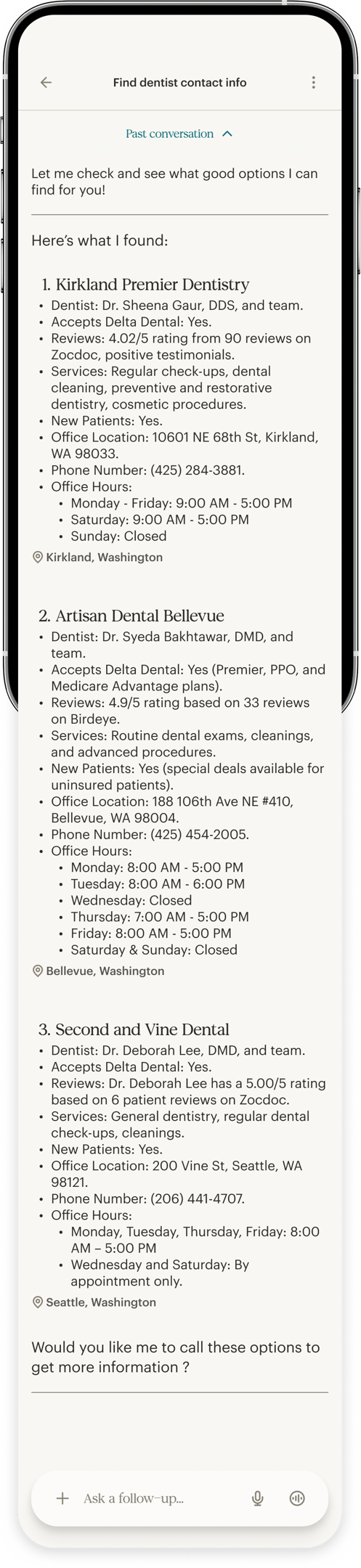
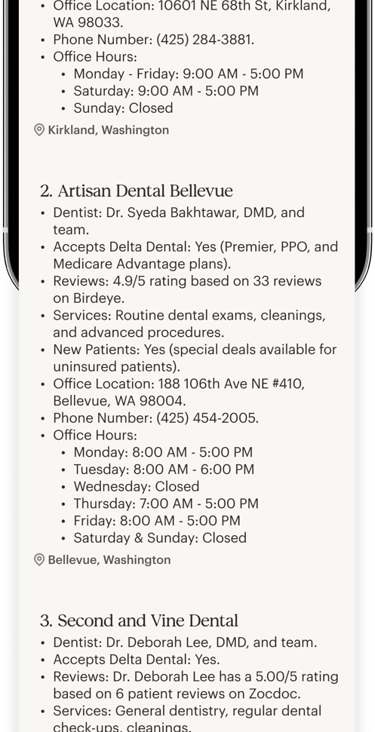
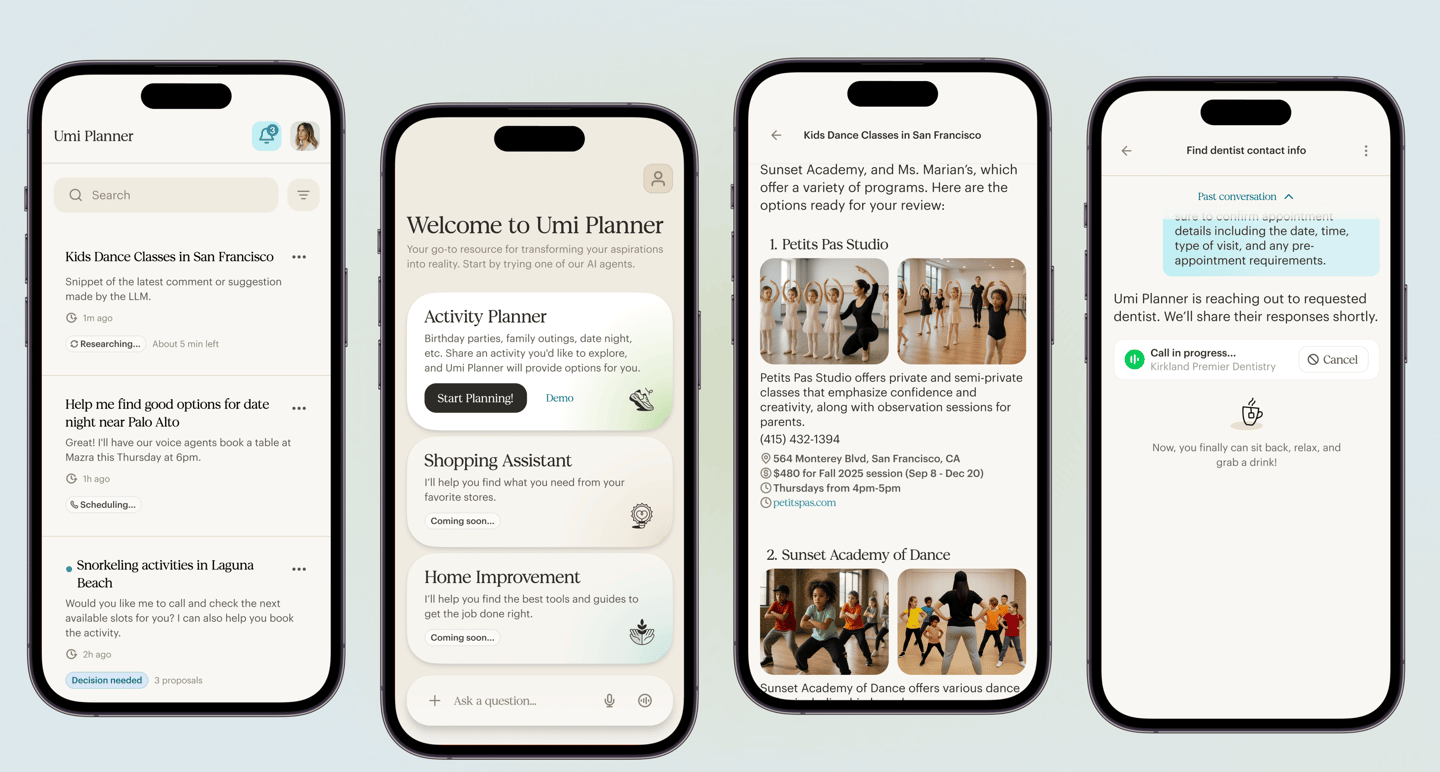
From household questions to answers to actions— AI handles the details so families don’t have to.
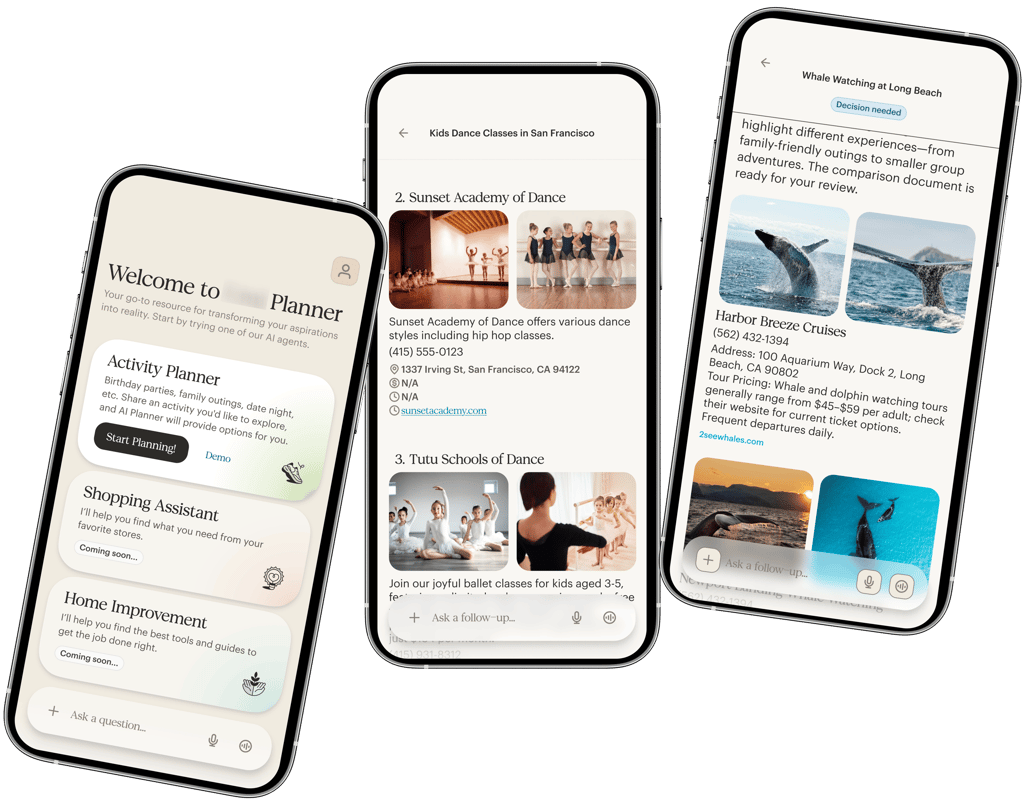
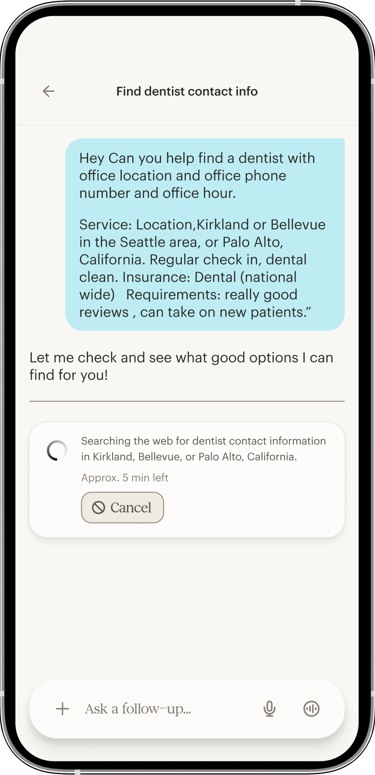
Families can submit questions about daily tasks or activities, and AI generates tailored suggestions and actionable results
Ai Agent always asks follow up actions
Would you like me to call these options to get more informations?
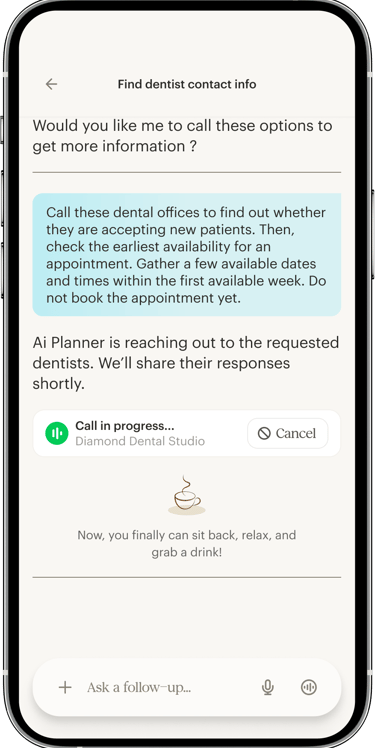
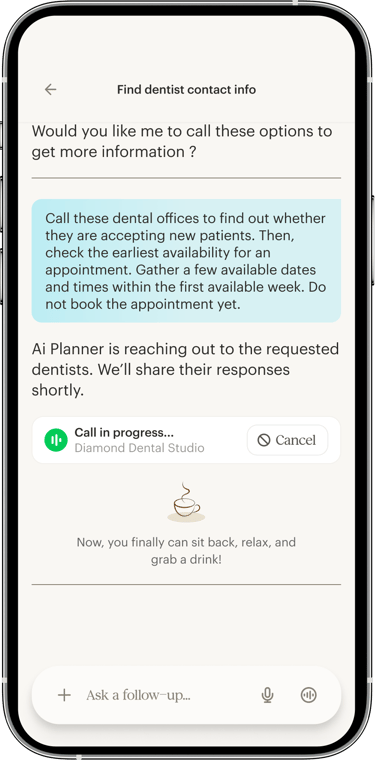
Do you want me to help book an appointment for you now, or check anything else first?
Want me to add them to your calendar?




AI offers to take real-world actions: make calls, ask additional questions, or schedule on the user’s behalf.
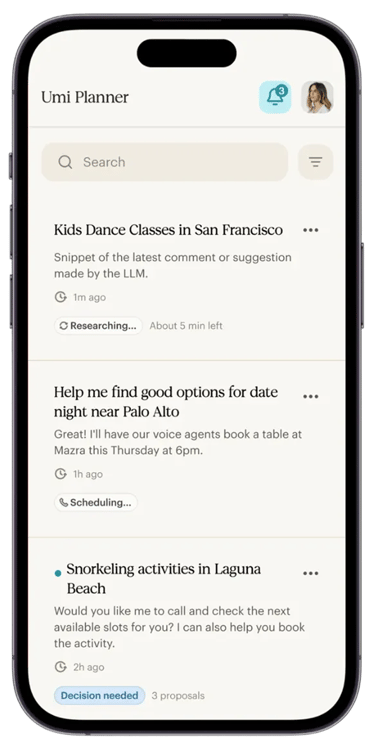
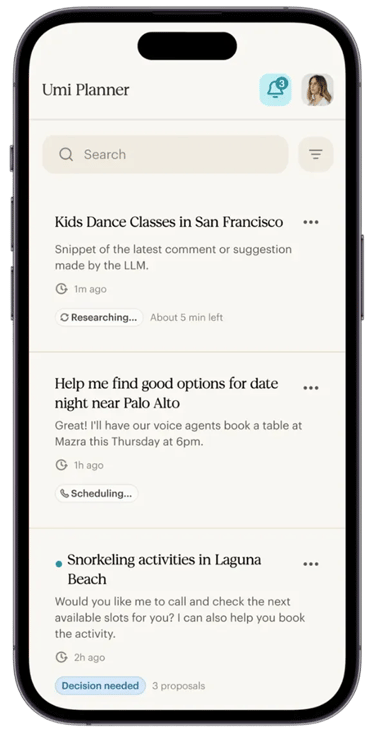


All requests are tracked in home page, showing their status: researching, scheduling, or waiting for user input if additional information is needed to complete a task.
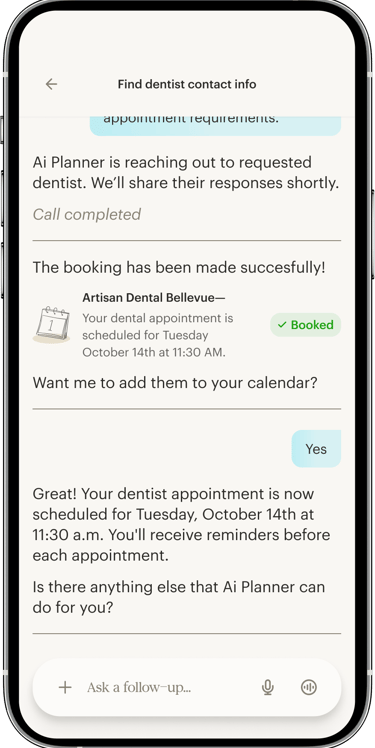
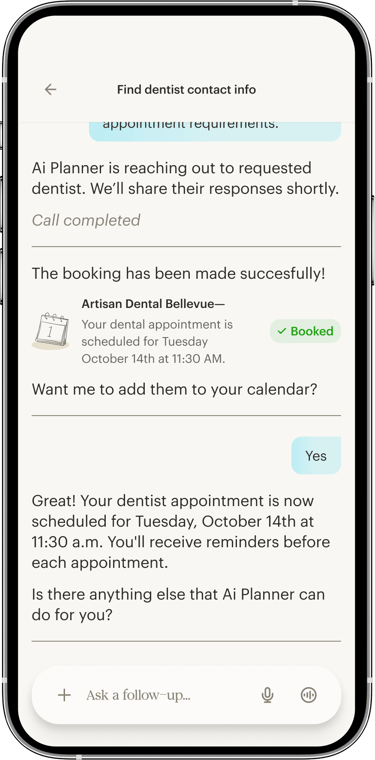
Listen to the AI call »
Asking Questions, Receiving Curated Results
From Answers to Action
Tracking Requests in One Place
AI That Acts on Your Behalf
We used Blend AI (voice-AI platforms) to explore how AI could handle real-world follow-ups that often block families from completing tasks. By allowing the AI to place phone calls, gather availability, and return summarized results, the experience reduced interruptions and enabled families to make informed decisions quickly—without losing control over the final action.
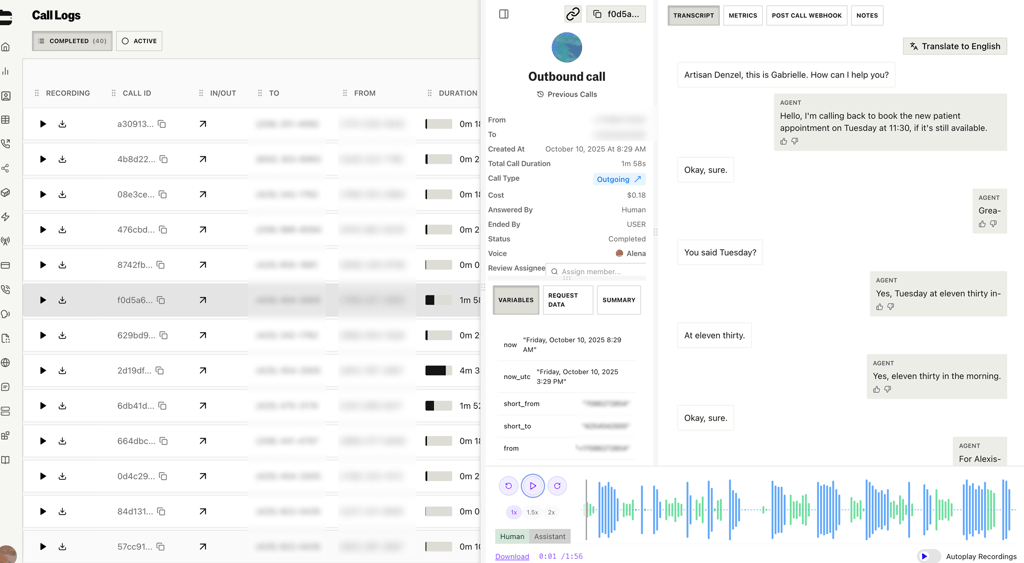
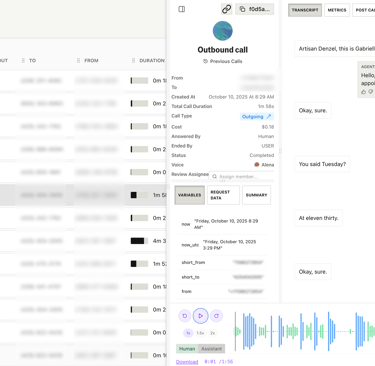
Making AI-initiated calls feel natural required careful prompt design. We shaped how the agent spoke, listened, and paused—teaching it to recognize live conversations, voicemail, and automated systems. By designing for these real-world nuances, the calls felt smoother and more respectful, creating a better experience for both users and businesses.
Designing Conversations, Not Just Calls
Designing the Nuances of Conversation






Challenge 1
Designing Beyond the Happy Path
Most real-world tasks don’t resolve perfectly on the first try.
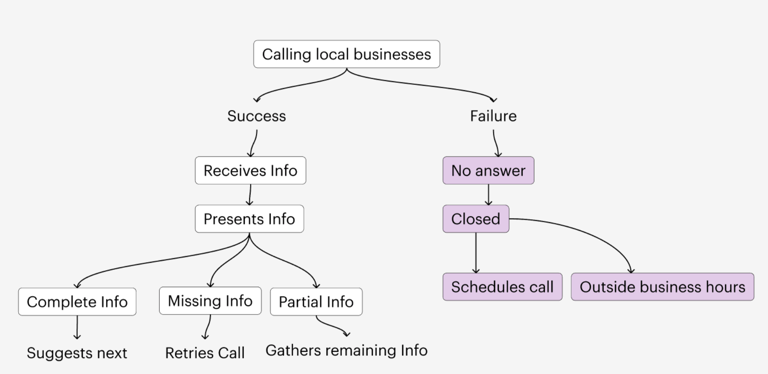
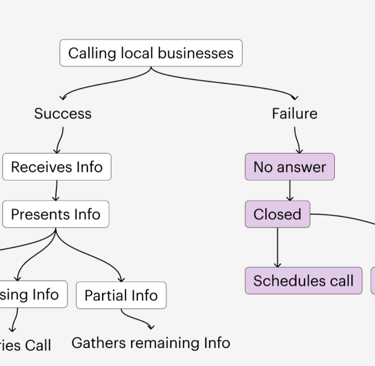
The ideal flow—ask, choose, book—was only part of the experience.
We needed to design for moments when AI couldn’t complete a task smoothly: unanswered calls, closed businesses, long queues, or results that didn’t meet expectations.
The challenge was defining how the system should recover—when to update users, what alternatives to suggest, and how to keep tasks moving forward without causing confusion or frustration.
Challenge 2
AI Accuracy & Context Awareness
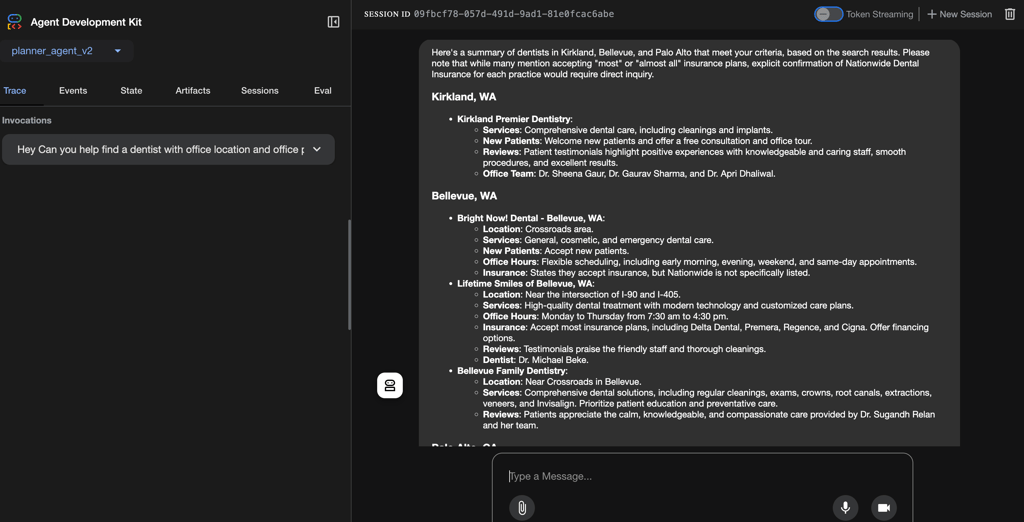
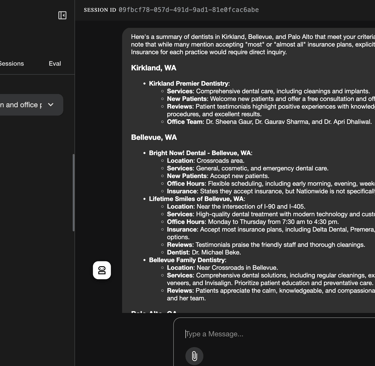


If AI responses aren’t precise, even the most thoughtful design can fail.
Developers used an AI testing tool to validate responses before integrating them into the product. We found that results were highly sensitive to how questions were phrased—missing or unclear details like location or dates often led to inaccurate or outdated results. Improving context awareness was critical, as unreliable AI output would quickly break user trust.
Example prompt included a target date, but the AI surfaced outdated festival information.


unanswered calls
closed businesses
long queues


Unexpected results
Call immediately drops
Carrier rejects the call
Spam detection

Interactive Voice Response rejection
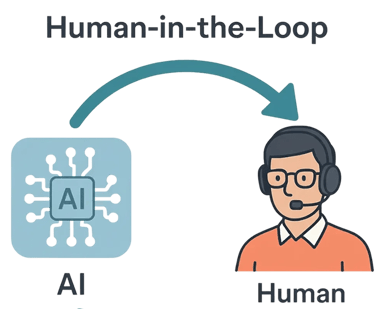
Human in the Loop
Automated phone calls can fail in many unpredictable ways. Instead of canceling the request or leaving users without an outcome, we designed an escalation path as part of the system. After multiple failed attempts, the task would be handed off to a human in the loop, ensuring the work can still be completed and the user isn’t left stuck in an automation loop.
When Automation Stops, a Human Steps In